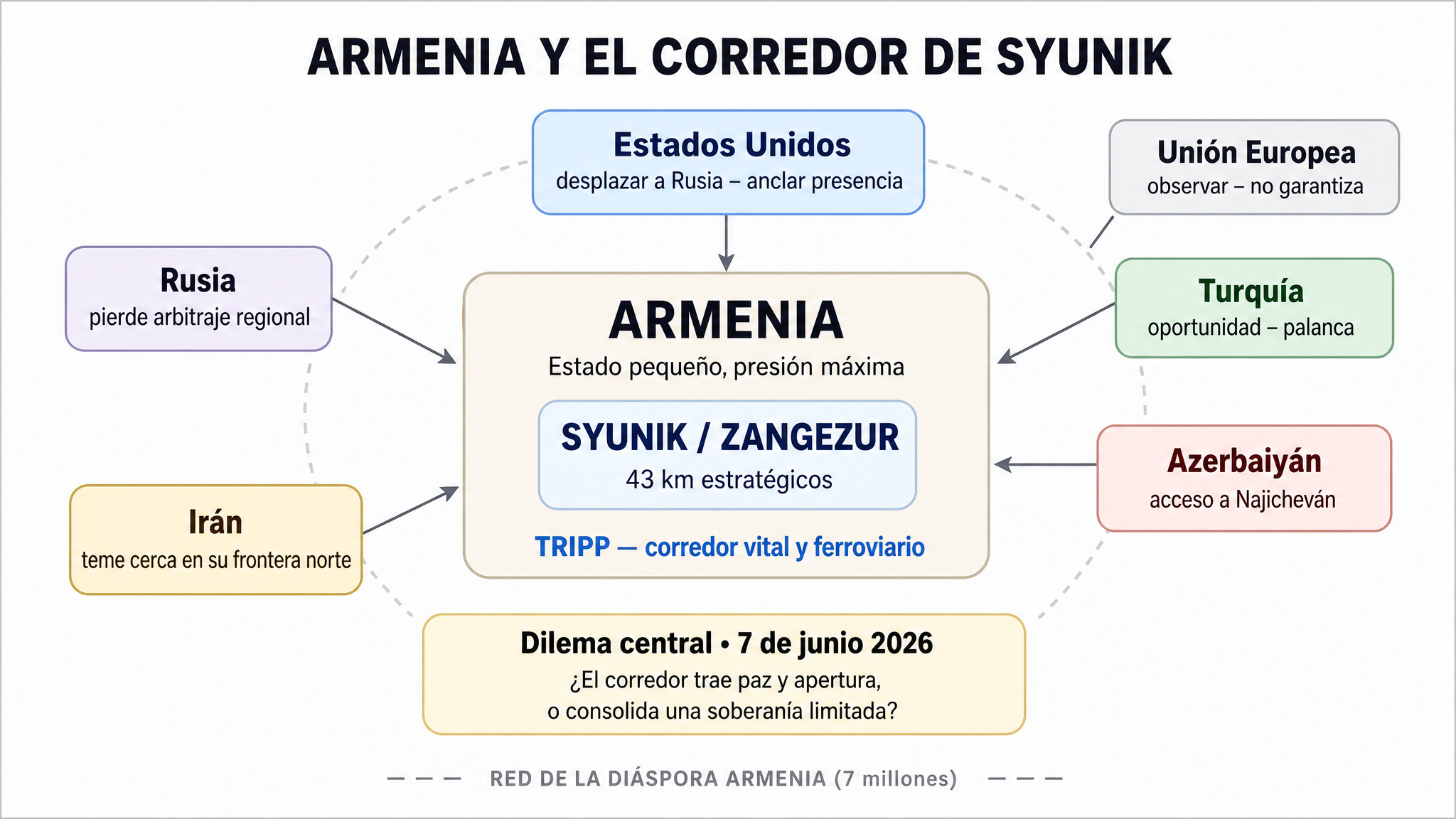
On June 7, Armenia will vote at one of the most complex moments in its recent history. The United States, Turkey, Azerbaijan, Russia, and Iran are each pushing in their own direction, while the European Union watches but offers no guarantees. Armenians will attempt something they have been trying to do for five thousand years: decide for themselves. History, as always with Armenia, does not wait.
I. The Geographical Curse
There are countries that history chooses as its stage. Armenia is one of them. Nestled between the Black Sea, the Caspian Sea, and the Arab-Persian world, the Armenian Highlands served for millennia as the unavoidable passageway for any army seeking to move between east and west, north and south. Persians, Macedonians, Romans, Parthians, Arabs, Seljuks, Mongols, Ottomans, Safavids, and Russians all conquered, massacred, and moved on. Armenians learned to survive without a state, with the Church serving as the backbone of a nation without territory and the diaspora functioning as its support network.
This is the key to understanding what Armenia may become by 2031: a people that has spent five thousand years perfecting the art of existing when everything conspires against its existence. And at the center of that story, there is always a corridor.
II. Syunik: The Same Place as Always
There is a province in southern Armenia, narrow as a bottleneck, linking the country to Iran while separating Azerbaijan from its exclave of Nakhichevan. Its name is Syunik. With its mountains, medieval monasteries, and strategic location, it has become the hottest geopolitical flashpoint in the South Caucasus. This is no coincidence—it is geography in its purest form. Whoever controls these 43 kilometers controls the passage between the Caspian region, Turkey, Iran, and the Arab world.
Armenians call this strip Syunik. Azerbaijanis call it Zangezur. Russians once referred to it as Meghri. Donald Trump gave it a new name: TRIPP (Trump Route for International Peace and Prosperity). Different names. The same territory. Different eras. The same recurring pattern: great powers demanding passage through Armenia.
III. From Tigranes the Great to the White House Agreement
Recent history follows a harsh but coherent logic. The railway lines that, during the Soviet era, connected Nakhichevan to the rest of Azerbaijan through Armenia were severed in the early 1990s when the conflict over Karabakh erupted. Since then, Baku has demanded the restoration of that connection—but on its own terms: no Armenian customs controls, no Armenian border checks, and no effective Armenian sovereignty over the route. For Armenia, such a formula has always been unacceptable for one fundamental reason: a corridor without sovereignty is, in practice, ceded territory.
Following the military defeats of 2020 and 2023, and with Karabakh definitively lost, Prime Minister Nikol Pashinian negotiated from a position of extreme weakness. On August 8, 2025, at the White House, he and Ilham Aliyev signed a preliminary peace agreement before Donald Trump. The central component of that agreement is TRIPP: a 43-kilometer road and rail transit corridor through Syunik connecting Azerbaijan with Nakhichevan, developed exclusively by American companies. In January 2026, the U.S. State Department formalized an arrangement under which Armenia would grant the United States a 74 percent stake in the company managing the corridor. Last week, Marco Rubio traveled to Yerevan to advance additional agreements related to TRIPP and to discuss U.S. access to Armenia’s critical minerals—another strategic priority in Washington’s global competition with China.
IV. Five Powers Competing Over Syunik
What is at stake in those 43 kilometers of Armenian mountains is not merely a transportation project. It is the reconfiguration of the entire South Caucasus, and every major actor has its own reasons for being involved.
The United States seeks two simultaneous objectives: displacing Russia from the South Caucasus and securing a commercial corridor linking Central Asia with Turkey and Europe without dependence on either Moscow or Tehran. The name TRIPP is not simply presidential vanity—it is a geopolitical brand designed to anchor a permanent American presence in a region where it has never previously established one.
Turkey is the silent major beneficiary. The corridor would complete the land connection between Turkish territory and the broader Azerbaijani and Turkic world beyond the Caspian Sea, a central pillar of Ankara’s long-standing pan-Turkic vision. The Middle Corridor, which links China to Europe while bypassing Russia, is expanding rapidly, and Syunik is its missing link.
Azerbaijan finally obtains what it has always demanded: direct physical access to its exclave. After winning two wars, Baku transforms military victory into a permanent territorial architecture, this time with Washington’s endorsement and without firing another shot.
Russia is the principal loser. For three decades it served as the indispensable arbiter of the Caucasus, the security guarantor to which both Armenia and Azerbaijan had to answer. The August 2025 agreement left Moscow entirely outside the process. Its North–South Corridor, connecting Russia to India through Iran and Azerbaijan, loses strategic weight as the rival Middle Corridor gains momentum.
Iran is perhaps the most exposed actor. TRIPP weakens Tehran’s natural access to Armenia and the Caucasus while consolidating an American presence on its northern frontier at a time of maximum pressure from Washington and Tel Aviv. Armenia, aware of Iranian sensitivities, has assured Tehran that the corridor will operate under exclusive Armenian sovereignty rather than as an extraterritorial enclave. Whether that guarantee is substantive or merely formal remains an open question.
V. Peace or Another Trap?
This is the dilemma every Armenian—in Yerevan, Buenos Aires, Los Angeles, and elsewhere—should confront honestly: is TRIPP a historic opportunity or merely a repetition of a familiar pattern?
Supporters of the agreement argue that Pashinian had virtually no room to maneuver. Without Karabakh, without a competitive military, with Russia distracted by Ukraine, and without Western security guarantees, the alternative may have been an invasion of Syunik that Armenia could not have resisted. Under those circumstances, negotiating a corridor in exchange for peace, international recognition, and an American presence as a deterrent may represent the transformation of an unavoidable defeat into a possible opening.
Critics point to several vulnerabilities. First, granting a 74 percent stake in the management company to the United States effectively transfers control over a strategic strip of Armenian territory, regardless of diplomatic language. Second, the agreement was negotiated in secret, based on a 17-point framework agreed upon in March 2025 that was never presented to the Armenian public before signing. Third, it contains no provision for the dignified return of Armenians expelled from Karabakh in 2023. And fourth, Armenia’s history is full of foreign powers that arrived promising prosperity and respect for sovereignty. Their names differed—Ottomans, Persians, Soviets—but the pattern remained the same.
The Armenian government insists that this time is different: that TRIPP will function under Armenian law, with full state jurisdiction and no foreign military presence. Such guarantees will require rigorous monitoring. Armenian history teaches that written assurances and realities on the ground seldom coincide.
VI. What Armenia Has That Others Do Not
Regardless of which scenario prevails by 2031, one constant emerges from five thousand years of history: Armenia survives. Smaller than before, perhaps, but alive. With less territory, yet possessing one of the world’s oldest and most cohesive national identities.
And there is the diaspora: more than seven million Armenians living outside the Republic of Armenia. A network that finances hospitals, exerts political pressure in Western parliaments, publishes newspapers, and keeps the memory of the Armenian Genocide of 1915 alive as a continuing moral argument before the international community. The diaspora is—and will remain in 2031—Armenia’s true army. It does not fire bullets, but it votes in countries that influence the region’s future.
There is also something none of the five powers competing over Syunik possesses: Armenia is the only country that deeply understands all of its neighbors because it has been ruled by all of them. It knows Persian logic, Russian patience, Turkish ambition, and Azerbaijani pragmatism. In a Caucasus undergoing profound transformation, that knowledge could finally become a strategic advantage rather than a scar.
VII. 2031: The Corridor That Wants to Become a Destination
The year 2031 is not arbitrary. It marks the end of the mandate of the government Armenians will elect on June 7. That government will inherit TRIPP, peace with Azerbaijan, and the unresolved issue of the more than one hundred thousand Armenians expelled from Karabakh in 2023. Whoever governs Armenia during this period will oversee the first real evaluation of what was signed at the White House. They will also have to answer a question that is not strictly geopolitical but philosophical: can a people that spent five thousand years serving as a corridor for others finally become an actor with an agenda of its own?
The honest answer today is: not yet. Pashinian signed an agreement negotiated in secret, without public consultation, granting a foreign power a 74 percent stake in the management of a strategic corridor on Armenian soil, without securing anything for the Armenians expelled from Karabakh, and under conditions he himself described as “sign or face invasion.” Signing under threat is not the same as negotiating as an equal.
Yet there is one important difference from the past. When Persians, Romans, or Ottomans crossed Syunik, Armenia had no say in the matter. It was the stage, not the protagonist, and no one even asked its opinion. Today, there is an Armenian state, a parliament that must ratify agreements, an opposition that speaks openly, a diaspora that exerts pressure from abroad, and a public that demands explanations. That may not amount to full sovereignty. But neither is it the helplessness of earlier centuries.
On June 7, Armenians will decide who guides that process. And even from afar, the diaspora will participate as well—with its memory, its influence, and its voice.
The corridor is tired of being a passageway. After five thousand years, it wants to become a destination.
June 7 will determine the direction. By 2031, we will know whether it was the right one—or whether, once again, others decided for Armenia.