SECCIONES
ARMENIA
LOCALES
DIÁSPORA
UGAB
INSTITUCIONES
EMPRENDIMIENTOS Y PYMES
OPINION
AGENDA
SOCIALES
EDICIONES

Temp.: -
Hum.: -
Lunes 08 de Junio - Buenos Aires - Argentina
PREMIO MEJOR MEDIO DE PRENSA PUBLICADO EN LENGUA EXTRANJERA - MINISTERIO DE LA DIASPORA DE ARMENIA 2015
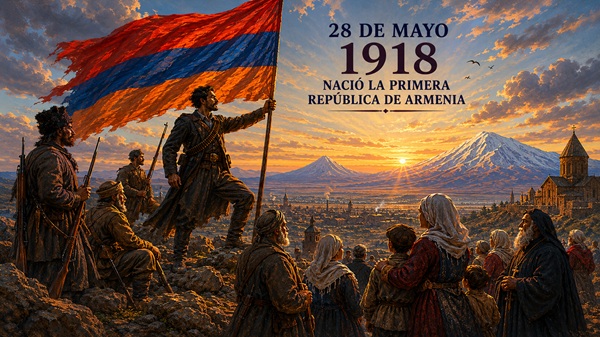
Opinion - May 28, 1918
The Day Armenia Rose Again
28 de Mayo de 2026

May 28, 1918 was not, for the Armenian people, a mere administrative proclamation or a diplomatic gesture in turbulent times. It was an existential response. When the collapse of the Russian Empire left the Caucasus exposed, when the Ottoman advance threatened to complete the destruction begun years earlier, and when the shadow of the Genocide stretched over the survivors, Armenia declared something deeper than independence: it declared that it would not accept its own extinction.

The First Republic of Armenia was born under conditions that are today difficult to fully imagine. It was born amid ruins, mass displacement, famine, disease, and a collective exhaustion that was not only material but spiritual. Yet from that landscape of loss emerged a political and moral decision: to organize, resist, and assert sovereignty where many—within and beyond the region—already believed no historical possibility remained for an Armenian state.

That is why May 28 cannot be understood without the battles of Sardarabad, Bash Abaran, and Gharakilisé. Those battles did not pit armies against each other alone: they pitted destinies. Soldiers fought, yes, but so did an entire society mobilized by the certainty that defeat meant the end. Sardarabad, in particular, did not merely defend Yerevan; it defended the political continuity of Armenia. It was the precise moment where history could have closed permanently—and instead, opened again.

The republic born then was short-lived: barely two and a half years. It was fragile, besieged, marked by extreme limitations and a hostile environment. But its brevity does not diminish its weight. In that period, institutions were founded, an independent diplomacy was tested, a modern administration was shaped, and above all, a principle was established that must remain non-negotiable to this day: sovereignty as a condition of national existence.

Remembering May 28 also demands resisting two temptations: empty nostalgia and routine solemnity. To commemorate is not to idealize, but to understand. To understand that national survival came at an immense human cost; that organization was as decisive as courage; and that identity was sustained not only in memory, but in the concrete capacity to build a state, institutions, and social cohesion under extreme circumstances.

For the Armenian diaspora, this date carries a complementary and profound significance. Millions of descendants of survivors grew up far from the historic homeland—but not far from Armenia. They carried it in community schools, churches, cultural centers, newspapers, associations, and families that refused to let exile become oblivion. May 28 belongs also to that diaspora, which sustained national consciousness when the state did not exist or when history seemed to have sealed it away.

And for contemporary Armenia—independent since 1991—May 28, 1918 is a root, not a footnote. The continuity of the modern Armenian state is bound to that republic born at the edge of the abyss. Without that generation that resisted, without that decision to transform survival into sovereignty, the very idea of an Armenian state in the twenty-first century would be something else—or perhaps would not be at all.

Today, in a world that once again normalizes wars, forced displacement, and threats against entire peoples, the lesson of 1918 retains a disquieting relevance. Nothing is guaranteed forever. National existence requires active memory, political responsibility, social unity, and institutions capable of protecting collective life.

May 28 is not only a date to remember what was won; it is a date to measure what must be safeguarded. More than a century ago, Armenia rose when many had counted it finished. Let that founding act not become mere ceremony; let it remain a compass. Because, as Sardarabad taught, history continues only when a nation decides that it will.

108 years ago, Armenia rose again. And that historic decision continues to challenge us to this day.

Más leídas