While demolishing the last Armenian churches in Artsakh, Azerbaijan "instructed" Armenia on how to commemorate April 24
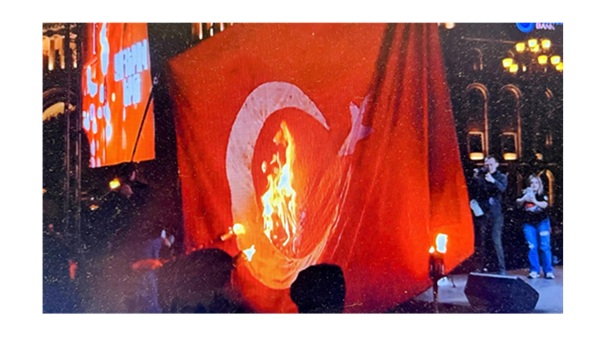
The Azerbaijani Ministry of Foreign Affairs issued a statement on Friday, April 24, condemning the burning of a Turkish flag during the torch procession in Yerevan on the eve of Armenian Genocide Remembrance Day, and demanding that the Armenian government "take appropriate measures" and "hold those responsible accountable." The tone is not that of a neighboring state expressing diplomatic concern. It is that of a power issuing orders to a subordinate government.
The statement that says it all
Azerbaijan did not merely express displeasure. It issued a formal document, laden with warnings and demands, dictating to the Armenian government what it should have done on the eve of April 24.
The text "strongly" condemns the burning of the Turkish flag during the April 23 procession and asserts that the Armenian government "should have prevented this campaign, based on ethnic hatred, and taken appropriate security measures in time."
It then goes further: "It is totally unacceptable to turn a blind eye to such inadmissible acts under the pretext of democratic norms, freedom of assembly and freedom of expression." In other words, Azerbaijan explains to Armenia that freedom of expression has limits — those that Baku deems convenient.
The statement describes the events as "a clear manifestation of a fascist, revanchist mentality based on ethnic hatred" and concludes with a direct demand: "We call on the Armenian government to hold those responsible for these acts accountable."
What the statement omits — and what the world must not forget — is that the April 23 torch procession is a century-old tradition of Armenian youth to commemorate the Genocide perpetrated by the Ottoman Empire, the historical predecessor and ideological ally of the Turkey that today backs Azerbaijan. That in this context someone burned a Turkish flag is not an act of ethnic hatred: it is an expression of historical grief that has a name, a date, and 1,500,000 victims.
Azerbaijan knows this. That is why it is bothered. And that is why it instructs.
Two churches. One week. Zero condemnations from Yerevan.
The words of the Azerbaijani statement become even harder to sustain in light of what was happening simultaneously in Artsakh. That very same week, Azerbaijani bulldozers were at work in Stepanakert.
On April 12, the Diocese of Artsakh reported the complete demolition of the Church of Saint Hagop, a temple that for years served as the center of liturgical life for the Armenian community, where thousands of faithful received the Eucharist every Sunday.
Days later, Azerbaijan demolished the Cathedral of the Holy Mother of God, the largest church in Artsakh. Its cornerstone was laid in 2006 by Catholicos of All Armenians Karekin II, and it was consecrated in April 2019. During the 44-day war, the church had served as shelter for thousands of civilians fleeing Azerbaijani bombardments of Stepanakert. Artsakh's cultural heritage ombudsman, Hovik Avanesian, noted that the demolition coincided with the 111th anniversary of the Armenian Genocide and that open calls to destroy the church had circulated on Azerbaijani social media before the event, without anyone being sanctioned.
Unlike when Azerbaijan proudly displays the demolition of Armenian government buildings, the destruction of the churches was carried out in silence, without official media coverage. The question is inevitable: do they find it uncomfortable to show the world how bulldozers bring down a Christian church?
Pashinian: "We will not take it to the international level"
The Armenian government's response was, in a word, nothing. Asked about the demolition of the churches, Prime Minister Nikol Pashinian declared that his concern is limited to "historical and cultural monuments located on the territory of Armenia" and ruled out turning the destruction into "a topic of international relations at the state level," arguing that in such matters "one must be prudent, because they are a double-edged sword."
"One Nation, Two States": who instructs whom
Under the motto "One Nation, Two States" — which defines the strategic alliance between Azerbaijan and Turkey — Baku publicly dictates Yerevan's actions while systematically erasing every Armenian trace in Artsakh. The irony is brutal: the same state that demands Armenia sanction those who burned a Turkish flag is the one demolishing Christian churches on the eve of the Genocide anniversary, without the Armenian government uttering a single word of condemnation.
These are not isolated incidents. Among the sites already destroyed in Artsakh are the Church of Saint John the Baptist in Shushi, the churches of Saint Sarkis in the villages of Tandzatap and Mokhrenes, the Church of Saint Hampartzum in Berdzor, and the Church of the Holy Mother of God in Mekhakavan, among many others. What is happening in Artsakh has a precise name: cultural genocide.
The Artsakh Agency for Tourism and Cultural Development stated it without euphemism: "It is not only buildings that are being destroyed, but also the identity of a people, their past, and their right to a future."
Silence, at this point, is no longer neutrality. It is complicity.
Sardarabad Editorial Staff