Azerbaijan has convicted Artsakh’s leadership of terrorism and of financing terrorism. Yet for years it was the Armenian state that paid Artsakh’s salaries, pensions, schools, hospitals and even its army. If those leaders are “terrorists,” the charge is really aimed at Yerevan. That is why Armenia should not sign a peace deal without first demanding their release.
On February 5 of this year, Baku’s Military Court sentenced Artsakh’s last president, Arayik Harutyunyan, and four other senior leaders to life in prison. Former presidents Arkadi Ghukasyan and Bako Sahakyan each received 20 years. Days later, former State Minister Ruben Vardanyan was also sentenced to 20 years. The Court of Appeals later upheld every sentence.
Several organizations, including Amnesty International, called the proceedings a sham. Civilians were tried by a military court, and the hearings were open only to state media. None of the defendants pleaded guilty.
Among the dozens of charges, two deserve particular attention: terrorism and financing terrorism. Not because they are credible, but because of what they imply.
Who paid the bills
Artsakh was never able to support itself with its own resources, and nobody pretended otherwise. In 2019, the last year before the war, its budget came to 117.9 billion drams, and almost half of it came from Armenia.
After the 2020 war, the dependence became almost total. In 2021, Artsakh’s budget took in 174 billion drams, and 128 billion of that came from Yerevan: 73% of the total, more than $250 million.
In 2022, the Armenian government had planned to transfer 144 billion drams and ended up sending 176 billion, about $400 million. For 2023 it again budgeted 144 billion, more than 5% of all Armenian state spending, and approved additional funds even during the blockade of the Lachin corridor.
What was that money used for? I’m not the one saying it. Nikol Pashinyan himself said it in Parliament in June 2022, when he was being accused of abandoning Artsakh. Those funds paid the salaries of every public employee, pensions, social benefits, health care and education. Pashinyan presented it at the time as a point of pride: Armenia had never helped Artsakh so much.
The money was transferred as an “interstate loan” at a token interest rate of 0.001% a year. And when Azerbaijan seized Artsakh by force in September 2023, the Armenian state did not walk away from those accounts either. That December, the government decided to take on the debts Artsakh owed to Armenian banks: about 315 billion drams, roughly $780 million. In other words, the Republic of Armenia formally assumed those obligations as its own.
The army too
If Armenian funds paid the salaries of every public agency in Artsakh, as Pashinyan acknowledged, that included the Ministry of Defense and the Artsakh Defense Army, whose command is now imprisoned in Baku. Artsakh’s military spending was never made public; it was discussed behind closed doors. But the math is simple. If almost three quarters of the budget came from Yerevan, there was no way to sustain an army without that money.
The military link was even more direct. For two decades, thousands of young men from Armenia did their compulsory military service in Artsakh. In the 2020 war, units of the Armed Forces of Armenia fought alongside the Defense Army. Only in mid-2022 did Yerevan announce it would stop sending conscripts.
Artsakh was not an adventure by a handful of leaders. It was state policy of the Republic of Armenia for thirty years, sustained with its budget, its soldiers and its weapons.
Baku’s trap
The reasoning is simple. If governing Artsakh was terrorism, and if the one who paid for that administration for years was Armenia, the conclusion follows on its own: the financier of terrorism would be the Republic of Armenia.
This is not speculation. The indictment presented at trial already speaks of systematic support from Armenian state bodies, its military leadership and diaspora networks. The trial of Artsakh’s leaders was, in effect, a trial in absentia of Armenia.
That is the real danger. Baku has put on record, in a final judgment, a narrative it can use whenever it suits it. With names, figures and alleged evidence in a case file, nothing stops it from formally accusing the Republic of Armenia of sponsoring terrorism tomorrow. It could do so to demand reparations, to set conditions in negotiations or to pressure Armenia in international forums. And the peace agreement, which has yet to be signed, contains no safeguard today to prevent it.
The diaspora is not left out either. If the indictment mentions “diaspora networks,” every fundraiser, every solidarity campaign and every contribution our communities sent over decades to build roads, schools or homes in Artsakh could one day fall under the same label.
An obligation, not a favor
Demanding the release of the prisoners in Baku is not just a humanitarian gesture. It is an obligation that Armenia should not subordinate to the convenience of the negotiating table.
Those men governed a territory with money the Armenian state sent them. They led an army that Armenia funded and manned with its own soldiers. They carried out a policy that Yerevan sustained under every one of its governments, Pashinyan’s included. If they are serving life sentences today, it is for having done on the ground what the Republic of Armenia decided and paid for. Abandoning them would be admitting that the Armenian state uses its people and then washes its hands of them.
Peace should not be signed while they remain in prison
The time to demand it is now. The comprehensive peace agreement between Armenia and Azerbaijan was initialed in Washington in August 2025, but it has not yet been signed. The Armenian government keeps saying it is ready to sign as soon as possible, even before the end of the year.
Baku, by contrast, is in no hurry and sets conditions: it will not sign until Armenia amends its Constitution. Azerbaijan makes peace conditional on its interests; Armenia makes it conditional on nothing. And meanwhile it keeps giving ground: the Armenian Parliament has just ratified the framework agreement for the so-called Trump Route through Syunik.
If Baku sets conditions, Yerevan can and should do the same. The release of all Armenian prisoners, starting with Artsakh’s leaders, must be an inseparable part of signing the comprehensive peace agreement. Not as a goodwill request for later, but as a precondition. Signing while they are behind bars would mean accepting a peace built on a ruling that accuses Armenia of terrorism, and leaving those men as a permanent bargaining chip in Azerbaijan’s hands.
And yet the same Pashinyan who in 2022 proudly pointed to every dram sent to Artsakh is now silent in the face of a ruling that criminalizes his own state. Yerevan has chosen not to confront Baku in the name of the “peace agenda,” just as it does with the repeated territorial claims of “Western Azerbaijan” on Armenia itself. But staying silent about this accusation does not neutralize it: it validates it. And no peace deserves the name if it leaves one’s own prisoners in the other side’s jails.
The leaders imprisoned in Baku are not there because they are terrorists. They are there because they governed and defended Artsakh on behalf of the whole Armenian nation, with the money and soldiers that Yerevan gave them and now prefers not to mention. Demanding their release before signing the peace is paying a debt Armenia owes them. And it is also, even if Yerevan refuses to see it, defending Armenia itself against an accusation that already hangs over it.
-------------------
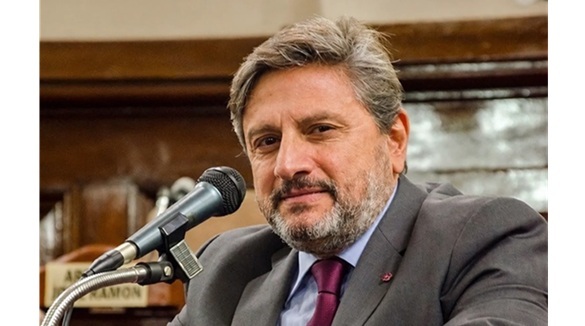
Sergio Nahabetian is the director of Diario Sardarabad (www.sardarabad.com.ar) and president of the Tekeyan Cultural Association of Buenos Aires. As a member of the Buenos Aires Provincial Legislature, he authored Law 13,478 recognizing the Armenian Genocide, which the provincial legislature passed in 2006.