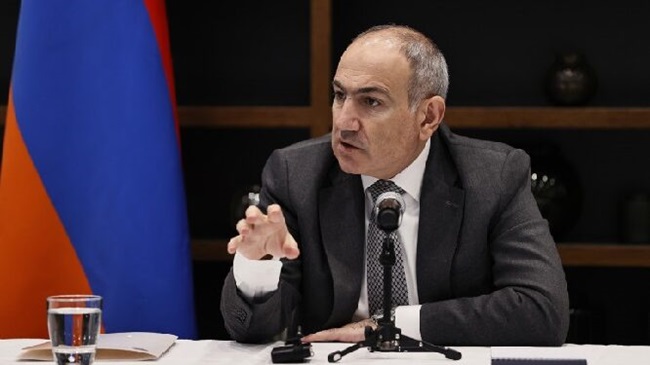
Armenian Prime Minister Nikol Pashinyan has once again ignited debate within the global Armenian community by describing the demand for international recognition of the Armenian Genocide as "imperial and anti-Armenian policy." The controversial remarks were made on March 26 during a cabinet meeting in Yerevan, less than a month before the 111th anniversary of the Genocide.
"Peace is not only a political concept, but also a socio-psychological one," Pashinyan stated. He argued that speaking of return — both of Armenians displaced from Karabakh and of the Armenian people in general — amounts to preventing those people from settling and accepting their situation. "Peace is when a person calms down, understands, and doesn't have their suitcase packed," he declared.
The Prime Minister went further, directly challenging the diaspora's historic struggle: "We have been living with this expectation for 100 years, and that is an imperial policy, an anti-Armenian policy, according to which, if you don't calm down, you will return or we will return; first will come the international recognition of the genocide, then you will return to Van, Mush, Cilicia..." According to Pashinian, this policy pursues two objectives: to keep the Armenian people in a refugee mentality and to prevent the consolidation of the Republic of Armenia as a state.
These statements are part of an escalating series of positions that have been shaking the international Armenian community for months. In March, Pashinyan had already told Turkish journalists that "international recognition of the Armenian Genocide is not among the priorities of our foreign policy today," and went so far as to question the usefulness of recognition resolutions adopted by the parliaments of dozens of countries, suggesting they generate tensions in the region.
In another recent statement, he also rejected the very notion of historical justice: "I believe we must pursue a just reality, not the restoration of historical justice. The more we pursue historical justice, the more we will face new historical injustices."
In January, during a meeting with the Armenian community in Switzerland, Pashinian appeared to cast doubt on the established historical narrative of the Genocide, asking how it was possible that in 1939 there was no "recognition agenda" and that one had only emerged in 1950. The Lemkin Institute for Genocide Prevention warned that these statements reinforce Turkish denialist narratives.
Reactions were swift and strong. Armenian opposition leaders described the government as a "collaborationist regime that serves only Turkey and Azerbaijan" and characterized Pashinyan's approach as "political immorality and treason." The Armenian diaspora responded with particular force: for the millions of Armenians living outside Armenia — many of whom have lost the language and other cultural markers — the struggle for Genocide recognition is one of the few remaining pillars of identity that still holds them together as a people.
All of this unfolds against the backdrop of a rapprochement process between Armenia and Turkey that Pashinian is actively promoting, which includes the possible opening of borders and the establishment of full diplomatic relations. Critics warn that this shift not only betrays the memory of more than one and a half million victims, but also emboldens Turkey and Azerbaijan, countries that have systematically denied the Genocide.
The Armenian diaspora sustained the memory for more than a century. It funded schools, built churches, raised its children in a language the world had given up for dead, and won Genocide recognition country by country, with patience and conviction. That today it is the Prime Minister of Armenia himself who questions that struggle is not merely a political provocation: it is a wound in the heart of what it means to be Armenian outside Armenia.
Pashinyan's statements are an affront to those who kept alive the identity of a people in exile, and a warning signal that cannot be ignored.